
2026 Is a Turning Point, Not a Trend
For more than a decade, Mexico has attracted foreign buyers drawn by lifestyle, climate, and relative value.
In 2026, however, the narrative has shifted.
Mexico is no longer perceived as an “alternative” market. It is increasingly viewed as a strategic allocation within international real estate portfolios—particularly for investors from the United States and Canada seeking stability, diversification, and long-term usability.
What has changed is not only pricing or demand, but how informed buyers approach the market.
1. From Opportunity to Structure: Market Maturity in 2026
The Mexican real estate market—especially in internationally connected regions like the Riviera Maya—has reached a new level of maturity.
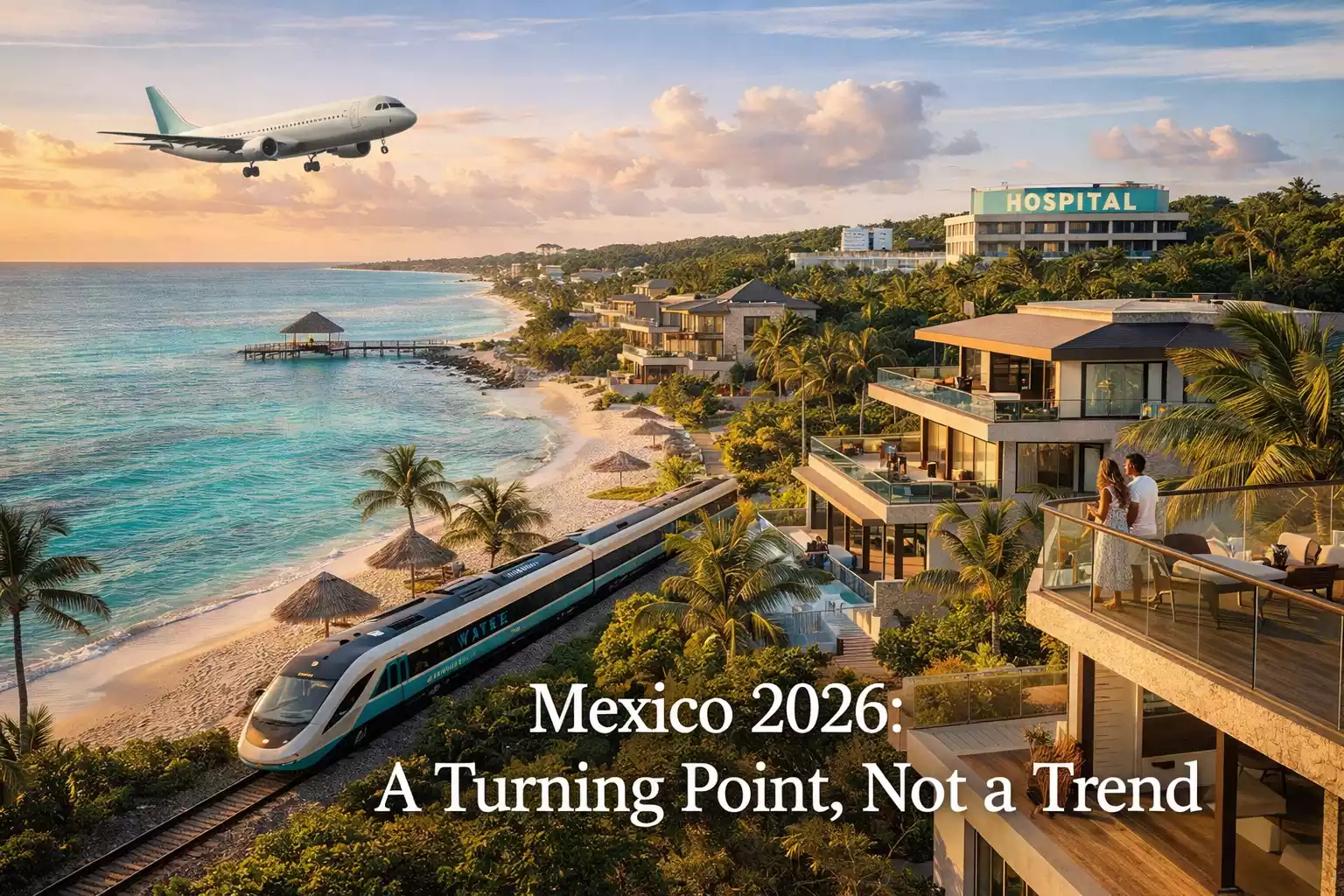
This evolution is supported by tangible fundamentals:
The full operation of the Tulum International Airport
Expanded regional connectivity through the Maya Train
Continued investment in private healthcare and residential infrastructure
A growing population of long-stay international residents and remote professionals
For global investors, these elements reduce execution risk. The market now supports long-term residential use, rental strategies, and resale liquidity in a way that was less defined a decade ago.
2. Legal Ownership: What Foreign Buyers Need to Understand
One of the most common concerns among international buyers remains ownership structure.
Foreigners can legally own property in Mexico. In coastal and border regions, this is achieved through a bank trust (fideicomiso)—a structure that has been in place for decades.
Under a fideicomiso:
The foreign buyer is the beneficial owner
A Mexican bank acts as trustee
The buyer retains full rights to sell, rent, remodel, or pass the property to heirs
The trust is renewable and transferable
In practice, this structure offers legal certainty comparable to other international ownership models and is widely used by U.S. and Canadian investors purchasing residential property in Mexico.
3. Why U.S. and Canadian Investors Continue to Lead Demand
In 2026, demand from North America remains particularly strong, driven by several converging factors:
Relative Value
While prices in Mexico have increased, they remain significantly below comparable coastal markets in the U.S., Canada, and much of the Caribbean—especially when measured against quality of construction, amenities, and location.
Currency Dynamics
Transactions are commonly denominated in U.S. dollars, providing clarity and reducing friction for foreign buyers managing cross-border capital.
Lifestyle Functionality
Markets like Playa del Carmen now support year-round living: international schools, private medical services, reliable connectivity, and a growing professional community.
For many investors, this allows a single property to serve multiple purposes—residence, rental asset, and long-term hold.
4. The Buying Process in 2026: Predictable When Properly Guided
A well-structured purchase in Mexico follows a clear sequence:
Property selection and due diligence
Purchase agreement and initial deposit
Setup of the fideicomiso (if applicable)
Notary-led closing process
Title registration
Mexican notaries play a central role, verifying ownership, legal status, and tax compliance. For foreign buyers, this adds an additional layer of oversight that often exceeds expectations.
The key variable is not the system itself, but the quality of advisory and due diligence guiding the transaction.
5. Rental Performance and Investment Logic
From an investment perspective, Mexico’s coastal markets continue to benefit from year-round demand.
In well-located developments:
Short- and mid-term rentals remain active
Rental returns vary by asset type and management strategy
Properties designed for long stays and residential use tend to show greater stability
Foreign owners who generate rental income must comply with Mexican tax registration requirements, a standardized process that can be handled efficiently with local professional support.
6. Why 2026 Requires a Different Investor Mindset
The most notable change in 2026 is buyer behavior.
Experienced investors are no longer asking whether Mexico is viable.
They are asking where, how, and with what structure to invest.
The focus has shifted toward:
Asset quality over volume
Residential usability over short-term hype
Markets with infrastructure depth
Advisors with local knowledge and international perspective
This reflects a broader global trend toward disciplined, long-term positioning rather than speculative entry.
Conclusion: Investing in Mexico in 2026 Is About Strategy, Not Timing
Mexico’s real estate market has entered a phase where success depends less on being early and more on being well-positioned.
For U.S. and Canadian investors, 2026 represents an environment of greater clarity: defined legal structures, mature markets, and sustained international demand. When approached with the right strategy and guidance, investing in Mexico can serve as a stable, functional component of a global real estate portfolio.
As a Global Real Estate Advisor, my role is to help investors navigate this landscape with precision—aligning market selection, ownership structure, and long-term objectives rather than reacting to trends.
In 2026, Mexico rewards informed decisions.

One Response